Rowing glossary: terms every new rower hears
Bow, stroke, crab, rating: the words you'll hear in your first week, explained in one line each.
By Civil Digital, the team building BoatLog · Last updated
BoatLog is independent software from Civil Digital. It is not affiliated with or endorsed by British Rowing or any organisation named in this guide. Always check the current official guidance and follow your club's own procedures.
The terms
- Bow
- The front of the boat, and the rower sitting nearest to it.
- Stroke
- The rower nearest the stern who sets the rhythm; also one complete rowing movement.
- Cox
- The person who steers and directs the crew, usually in the stern or lying in the bow.
- Sculling
- Rowing with two oars (sculls) each. Sculling boats are marked with an x, such as 1x or 4x.
- Sweep rowing
- Rowing with one oar each. Sweep boats include the pair (2-), four (4- or 4+) and eight (8+).
- Boat classes
- 1x single, 2x double, 2- pair, 4x quad, 4- coxless four, 4+ coxed four, 8+ eight. A plus means a cox; a minus means none.
- Rigger
- The metal or carbon frame that holds the oar out from the side of the boat.
- Gate
- The swivel on the rigger that the oar sits in, closed with a screw-down bar.
- Blade
- The flat end of the oar; also used for the whole oar.
- Heel restraints
- Ties that stop the heels lifting too far from the footplate, so feet come free in a capsize.
- Bow ball
- The rubber ball on the tip of the bow that reduces damage and injury in a collision.
- Catch
- The moment the blade enters the water.
- Finish
- The end of the stroke, when the blade comes out of the water.
- Feathering
- Turning the blade flat between strokes to reduce wind resistance.
- Catching a crab
- When a blade gets stuck in the water at the finish, jerking the handle into the rower.
- Easy there
- A call to stop rowing.
- Hold it up
- An emergency stop: blades squared in the water to stop the boat quickly.
- Rating
- Strokes per minute.
- Split
- Time per 500 metres, the usual pace measure on an ergometer.
- Erg
- An ergometer: an indoor rowing machine.
- Head race
- A time trial with crews starting one after another. See our head race guide.
- Regatta
- Side-by-side racing over a shorter course.
- Launch
- A motor boat used for coaching and safety cover.
- Landing stage
- The pontoon or bank where boats are launched and recovered.
- Circulation pattern
- The agreed traffic rules for a stretch of river, such as which side to keep to.
- Stream
- The speed of the river's current. Strong stream can stop rowing.
- RowSafe
- British Rowing's safety guidance for clubs.
- Junior categories
- Racing age groups such as J14 to J18, based on age on 1 September before the competition.
- Masters
- Veteran rowers, raced in categories by age.
How BoatLog helps
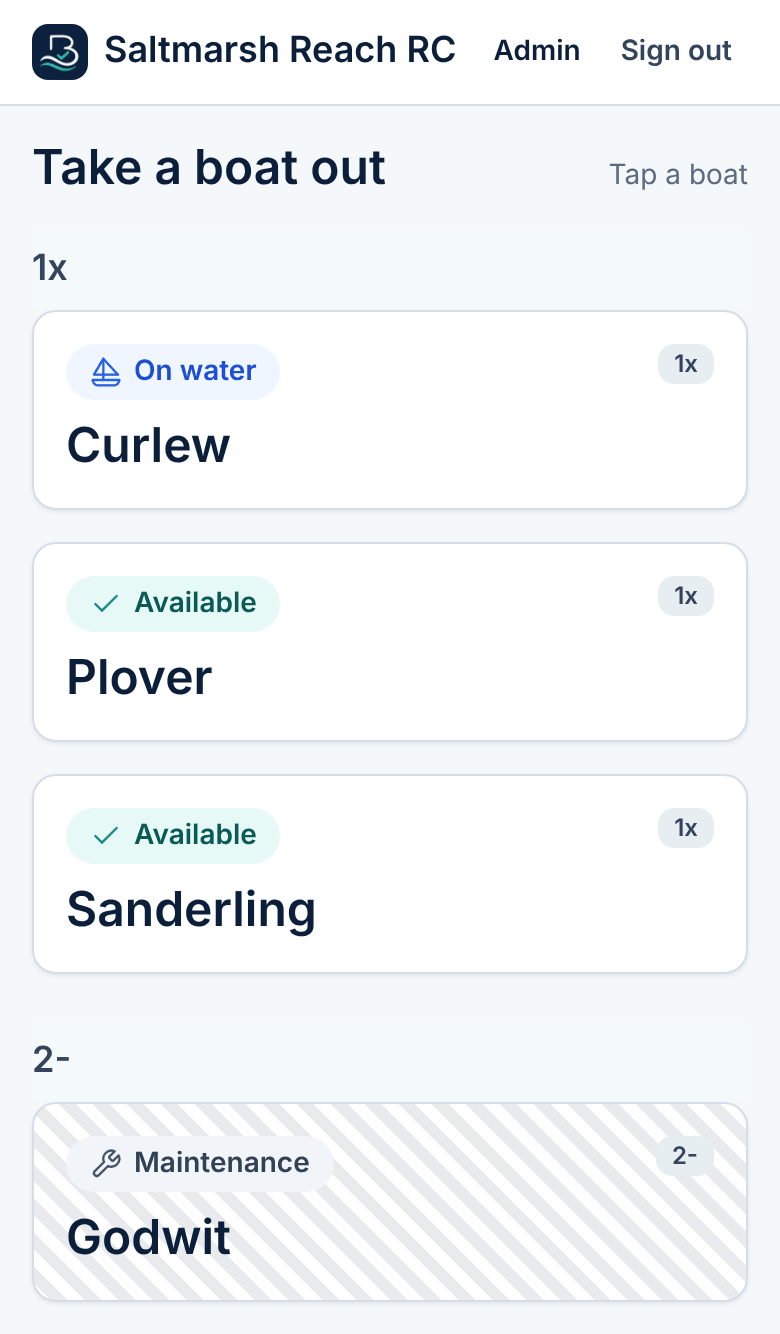
BoatLog groups the fleet by boat class, so members can find the right boat to sign out or book. New members can also read our parents' guide and swim test guide.
Questions
FAQ
What does 4x mean in rowing?
A quad: four scullers, each with two oars. The x means sculling.
What is the difference between sculling and rowing?
Scullers have two oars each; sweep rowers have one. Both are called rowing.
What does catching a crab mean?
When a blade gets stuck in the water at the end of the stroke, pulling the handle into the rower.
Related
More from BoatLog
Run a safer, simpler boathouse
Sign-out, safety flags, incidents, repairs and qualifications in one app built for UK rowing clubs. Start a free 14-day trial, no card required.